Operation Fear, redux

Who remembers Willie Horton? You could make an argument that without Willie Horton, George Bush the senior would not have been elected president, and hence his son would not have risen to power, and so no US attack of Iraq, and so on . . .

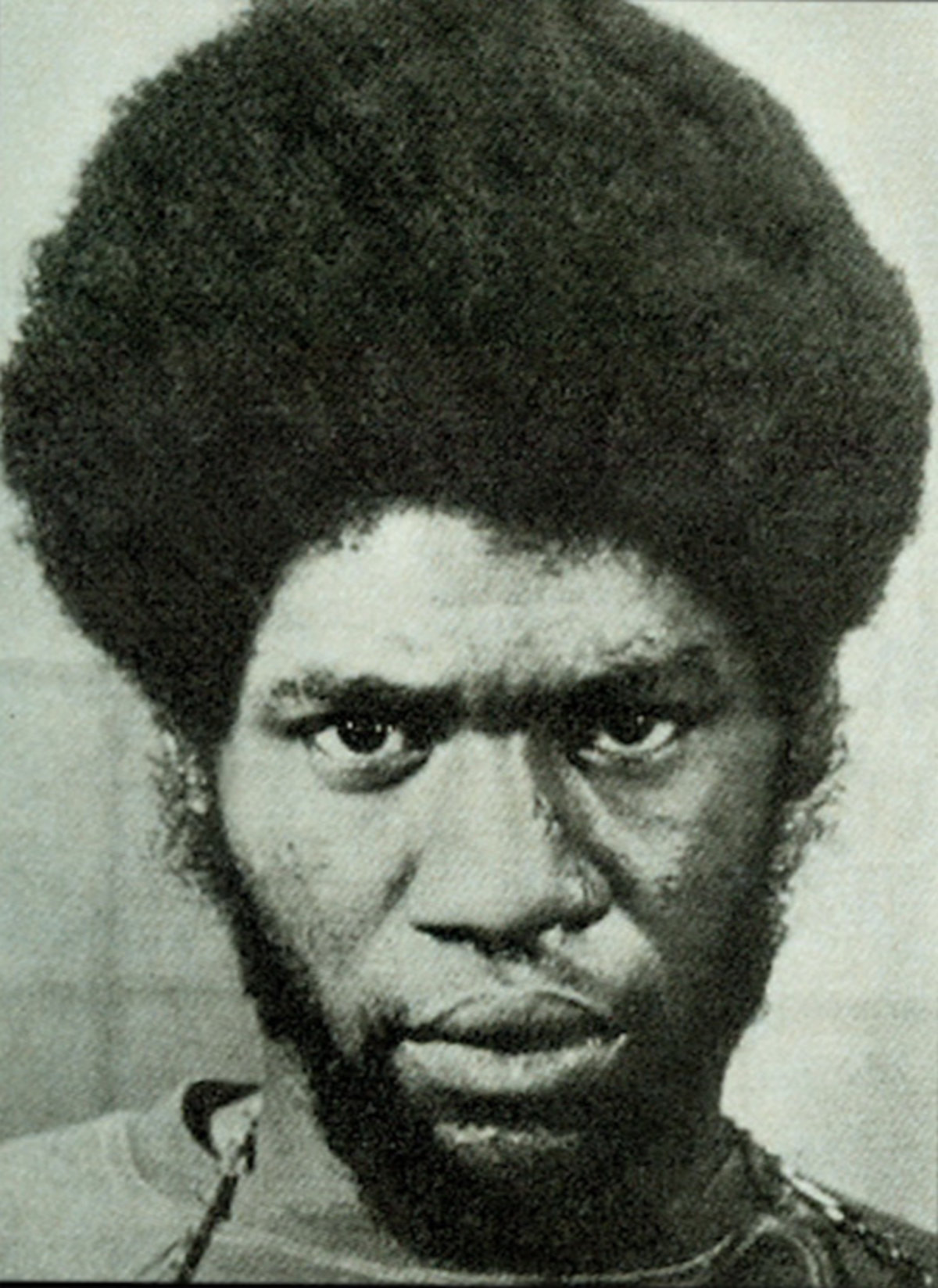
Horton

The successful centerpiece of a Bush campaign ad attacking Michael Dukakis (the Democratic candidate), Willie Horton embodied a wild, violent and very black criminality that scared the bejesus out of mainstream (i.e., White) American voters. A first, highly mediatized use of racial fears to win an election? I don’t know. But compare this to what is being termed the “opening salvoes in Operation Fear.” The latter day attack: David Cameron employing fear of migrants to spur opposition to Britain leaving the EU, threatening that France might no longer honor the agreement by which the UK operates its border controls on French territory (which is a key reason the squalid camp lies in France, not the south coast of the UK).

The politics of fear is but one aspect of the situation: the degree to which the fear of migrants, foreigners and refugees has eroded the ideals and principles behind safe refuge and the right to seek asylum. More importantly, the degree to which it has muted many of the voices one might expect to champion these very ideals, giving them loud voice in the public sphere (rather than a reticence in defense of institutional public image).

But the more insidious problem can be found in the mechanics underlying these tactics. Willie Horton was a violent, deranged killer. As an individual, he earned our fear. The secret of the ad’s success, though, traded on his face, an archetype of the guy hiding under your childhood bed. I wonder what it would have felt like to African-Americans, not simply to be feared on account of their skin, but to be feared so pervasively and effortlessly that it makes for a useful instrument.

What does it mean to the people in Calais (or those who are not, but might as well be), if they can so easily be used to evoke fears of invasion, of a swarming terror? Cameron’s underlying logic involves trading on the dehumanized foreigner, a meme for the modern bogeyman, usefully deployed to frighten not children but British voters into good behaviour. And so, the call to the humanitarian and human rights community is not simply to defend law and policies or to deliver assistance, but to counter (the principle of) humanity under attack and the equally powerful banalization of the attack. That is where it starts. That is where it always starts.

Refugees and Migrants: A New (old) Narrative

Imagine the scene. A desperate mass of stricken, exhausted, frightened people find refuge. Perhaps for the first time in years, they sleep with two eyes shut. Bam! A powerful group wrenches the money, jewels and property from their hands. Highway pillagers? Blood-thirsty criminal gang? Friends of Joseph Kony? Nope, nope, nope. That’s the work of the Government of Denmark and the Government of Switzerland (see e.g., here). In other words, it is the cunning policy of governments obligated by law to protect these very people. Governments, I might add, one does not usually associate with regime thuggery. This doesn’t pass the smell test.

In a related example of erecting clever barriers because a wall seems too crude, Obama’s US government will set up screening centers in Latin America, to “head off migrants . . . before they start traveling to the United States.” And who will be implementing these barriers screening centers? No, not Donald Trump. It’s UNHCR, the UN agency dedicated to defending refugees and the right to seek asylum.

Denmark? Switzerland? Obama? UNHCR? With friends like these … And lest the humanitarian community feel superior, let us remember that the appeals for money to fund programs in Syria have been unmistakably louder than appeals for Western governments to open their doors. A logic reminiscent of George Bush has evolved: if you help us feed/clothe them over there, they won’t come over here.

As Sara Pantuliano and others have astutely argued, it is time to change the narrative. Rather than view migrants as risks (or, for that matter, leeches, criminals and terrorists), she elaborates, the debate needs to be reframed to recognize “the substantial social and economic contribution they can make to their host societies.” Certainly, a more balanced understanding of migrants and refugees is necessary. But will a more accurate, positive spin on the situation work?

I have my doubts. Once a public debate is permeated by fear, once politicians seize upon those fears to gain power, once a gaping us-them divide blocks humanizing discourses . . . Well, let’s just say it becomes extremely difficult to engage in the sort of discussion where facts possess the power of persuasion. Look at the gun control debate in the US, or the past decade of immigration debates that have cropped up in much of Europe.  People become fact-resistant, positions entrenched, opinions shouted at the other side. In the situation we have today, facts don’t matter as much as we would like to believe.

More importantly, arguing the facts, arguing the other side of the coin, does not reframe the debate, it reinforces it. By accepting those terms for the discussion – the pros and cons of refugees – one undercuts the idea that asylum and refugee decisions should be based on principles, on the law, on an ethic of compassion. To reframe the debate, we need to discuss what is right and what is human, regardless the consequences. We need to avoid the a policy discourse of self-interest: asylum cannot depend on whether or not the safe haven needs you. Is Germany’s open door a more moral approach than other nations? Or a more enlightened understanding of domestic needs and migrant potential? I hope the former, I fear the latter.

If we want to salvage the sinking ship formerly known as the right to seek asylum, if we want to defend the 21 million refugees in the world, facts may be useful, but principles must be foremost. Not because loudly proclaiming what is right will win the argument, but because it is the argument most worthy of losing.

Thomas Jefferson and the 22nd Century

A New Year and a new baby have sparked my inner Carl Sagan, pondering the next century, musing on the meaning of life. That sort of thinking delivered me rather quickly to Thomas Jefferson.

Speculation about the future remains a dark art. When I was a kid, people imagined life in 2016 would be like The Jetsons (which, btw, takes place in 2062) not Downton Abbey with an internet connection. Extrapolating trends, the pundits prophesied both horrors and nirvanas. We watched 2001, A Space Odyssey and were convinced by its promise. We lamented never seeing a tight-suited Mick Jagger singing about Satisfaction again. Oh, how we were wrong.

Humanitarian crystal balls fare no better than others. When it comes to such predictions, I produced this piece in 2010, looking forward to 2020. Much more serious analysis can be found, for instance, in Randolph Kent’s work with the Humanitarian Futures project (e.g., see here). What about the far future? Not 2020 or 2050. What about a century or two from now? That’s where Jefferson comes in.

It would be difficult to identify a more brilliant politician, philosopher or steadfast champion of democracy, liberty and equality. Enter, stage left, the inconvenient truth that the man who found it “self-evident” that “all men are created equal” also bought and sold men as slaves. Let’s avoid a discussion of the historical and moral context circa 1775. The more pertinent question: When they study the current humanitarian age, what will prove our Jeffersonian blemish? What will leave people in 2116 shaking their heads, outraged at our deep moral and logical flaws? What constitutes our unrecognized racism? One answer: speciesism.

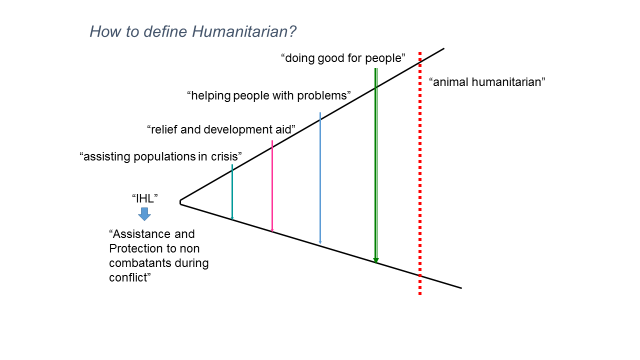
In scores of presentations during my MSF days, I used the slide below (stolen, with thanks, from JAB) to highlight the critical specificity of humanitarian action, distinguishing it from the much broader remit of do-gooderism issuing from a ‘humanitarian’ spirit (development, rights literacy, democracy promotion, gender equality, etc.). As the colored lines appeared, I asked participants whether they thought it a suitable definition of ‘humanitarian.’ Moving left from “doing good for people”, after a few iterations I would then jump out to ‘animal humanitarianism’ for comic relief, perhaps making fun of the (surprisingly successful) organization Donkey Sanctuary. “Has somebody lost the plot?” I would ask. “Is there some confusion over the first five letters of the word ‘humanitarian’?” Hell no doubt reserves a special pitchfork for the sanctimonious.

What is humanitarian action? JAB chart


The paramount principle of humanity places the fundamental human dignity of all people at the heart of the humanitarian ethos. This amounts to and is part of a larger exceptionalism – granting to humans a set of protections that are denied to other species. It yields a classification, as did race, onto which we graft great significance, including a conviction in our own superiority. There is too much similarity with racism not to wonder whether a future enlightenment will unfold, one holding that all life merits an equal degree of reverence, or at least conceiving of all life as possessing a magic, a magic so singular and astonishing that it renders irrelevant the differences between all of life’s diverse forms.

Right now, there are six boneless chicken thigh filets marinating in my fridge. In other words, I have not yet gone off the animal rights deep end, nor have I adopted dubious New Age philosophies such as Why I Identify as a Mammal. It seems almost inevitable that the proud leaders of humanitarian action today will have their names sandblasted off memorials in the future, with 22nd Century students protesting our virulent speciesism and moral decrepitude (i.e., when we become history, we are not likely to become the heroes we secretly yearn to be).

The import of speciesism to humanitarians is to consider whether the most powerful way to protect humanity would be to stop pushing human exceptionalism. Why does humanitarian action neither embrace nor deploy a reverence for life itself, and does this deficit undercut respect for its central message that family, clan, tribe, race, gender and nationality must be subordinate to the single family of humanity? Perhaps all exceptionalism warrants condemnation because exceptionalism, be it that of Joseph Kony or the US government, inexorably yields atrocity. The Jeffersonian problem, of course, is that we may have to live another hundred years of tomorrows to recognize the atrocities of today.

Ebola: Lessons not learned

[Thanks to Aid Leap for publishing this on their website. Check it out here, along with lots of excellent thinking on aid.]

Tomorrow will mark 42 days since the last new case of Ebola in Sierra Leone, meaning the country will join Liberia in being declared Ebola-free. That brings the world one step closer to a victory over Ebola the killer.

But Ebola has another identity – messenger. We listened. It told us that many aspects of the international aid system are not fit for purpose. Many – too many – of the problems the outbreak revealed are depressingly familiar to us.

Pre-Ebola health systems in Sierra Leone, Guinea and Liberia were quickly overwhelmed and lacked even basic capacity to cope with the outbreak. The World Health Organisation (WHO) failed to recognise the epidemic and lead the response, and international action was late. Early messaging around the disease was ineffective and counterproductive. There was a profound lack of community engagement, particularly early on. Trained personnel were scarce, humanitarian logistics capacity was insufficient and UN coordination and leadership were poor.

The lessons learned should also come as no surprise: rebuild health systems and invest in a ‘Marshall Plan’ for development; make the WHO a truly robust transnational health agency and improve early warning systems; release funds earlier and make contracts more flexible; highlight what communities can do, and engage with them earlier. Except these lessons learned haven’t really been learned at all: they are lessonsidentified repeatedly over the past decades, but not learned. 

Why is the system almost perfectly impervious to certain lessons despite everyone’s good intentions? The short answer: these lessons are too simplistic. They pretend that the problem is an oversight, a mistake to be corrected, when in fact the system is working as it is ‘designed’ to work.  The long answer: what is it about the politics, architecture and culture driving the aid system that stops these lessons from becoming reality?

Take a simple idea, like reconstituting the WHO as an intragovernmental agency with a robust mandate to safeguard global public health, and the power to stop an outbreak like Ebola. Sounds great, but not new. So it also sounds like wishful thinking. It does not address the inherent tension between sovereignty and transnational institutions.

Think of it this way: the more robust an institution, the more of a threat it poses to the individual states that are its members, and hence the greater incentive for those states to set limits to its power. WHO was ‘designed’ not to ruffle feathers.

A robust WHO? Can you imagine the WHO ordering the US or UK governments to end counterproductive measures such as quarantining returned Ebola health workers or banning airline flights to stricken countries? It will never happen.

Here is the true lesson to be learned: at a time of public fear and insecurity, it would be political suicide for any government to allow such external interference. The problem isn’t the institution, it only looks like it is; the problem is the governments that comprise it. That is not to say that WHO cannot and should not be improved. It is to say that the solution proposed cannot address the fundamental problem.

Or take a complex idea, such as community engagement. Our Ebola research found that the ‘early stages of the surge did not prioritise such engagement or capitalise on affected communities as a resource’, a serious omission that ultimately contributed to the spread of the disease, and hence a key lesson learned (see e.g., this Oxfam article).

Disturbingly, this is a lesson with a long history. Here, for example, is what the Inter-Agency Standing Committee (IASC) found in evaluating the international response to the 2010 earthquake in Haiti. The relevance, virtually word for word, to the situation in West Africa speaks for itself:

The international humanitarian community – with the exception of the organisations already established in Haiti for some time – did not adequately engage with national organizations, civil society, and local authorities. These critically-important partners were therefore not included in strategizing on the response operation, and international actors could not benefit from their extensive capacities, local knowledge, and cultural understanding … This is not a new observation. Exclusion of parts of the population in one way or another from relief activities is mentioned in numerous reports and evaluations.

Why is this lesson so often repeated and so often not learned? Does the answer lie in an aid culture where ‘taking the time to stop and think – to comprehend via dialogue, engagement and sociological research – runs counter to the humanitarian impulse to act’? Our report also discusses a greater concern: the degree to which people in West Africa were treated ‘as a problem – a security risk, culture-bound, unscientific – to be overcome’. 

The ‘oversight’ is hardly an oversight: people in stricken communities ‘were stereotyped as irrational, fearful, violent and primitive; too ignorant to change; victims of their own culture, in need of saving by outsiders’. Perhaps that clash of cultures highlights why we should not expect community engagement to spontaneously break out simply because the problem has been recognised.

Powerful forces work against aid actors engaging with the community during an emergency, leaving us with a lesson that has not been learned even after years of anguished ‘never again’ promises to do better.

Lessons learned are where our analysis of the power dynamics and culture of the international aid system should begin, not where it ends.
Humanitarian Effectiveness (2)

My previous post on this topic prompted a slight twitter buzz, with Patricia McIlreavy astutely pointing out that the aid ‘oligarchy’ isn’t just the big INGOs, but donors and the UN as well.  Dead right on that one.  They all employ wield effectiveness in an exercise of power.

Effectiveness seems to be part of a powerplay within the oligarchy as well. By way of broad generalization, the question of effectiveness functions as a spotlight, used by people in desk chairs to examine the work of people with mud on their boots.  Sounds good, right?  What about the reverse?  When can Mud-on-Boots cast the same light on the work of Deskchair? More importantly, why doesn’t the functioning of the aid system drive Deskchairs to cast the same scrutiny on the mountain of Deskchair work in the system?

It should. The aid system comprises immense resources and people – energy and ‘action’ – at the level above the field project.  Having just sat through one, how do we assess the effectiveness of a conference on effectiveness? Better yet, what has been the collective effectiveness of years of debates, research, publications, workshops, tools, guidelines and previous conferences on effectiveness?  In other words, why don’t those of us thinking about effectiveness shine the light on our own work?

At great effort and cost, the aid system produces a spectacular amount of material designed to improve the effectiveness of aid. How does that translate into lives saved, or suffering alleviated? Might it even work as an impediment? I remember a medical coordinator in MSF telling me that in the span of six months in South Sudan she received over 600 recommendations from headquarters.  No doubt lots of good advice, but what is the combined impact on stressed out and under-resourced field teams? Trying to regulate or rationalize this onslaught of advice leads to discord at HQ, with staff feeling disenfranchised from the operational mission. Put differently, each and every one of those 600+ recommendations represented the aspiration and drive of somebody at HQ seeking their ‘fix’ of field involvement, their dose of ‘making a difference’.  That’s not speculation. That was my fix too.

[Spoiler alert. This post should end right here. The next bit is a real downer. I blame the start of a cold, wet final weekend to England’s so-called summer.]

Shining the spotlight of effectiveness on this work can be disconcerting. Much of my considerable HQ product seems rather obviously designed to have allowed me to be part of the crisis response based on a blind faith in its actual impact.  This is a faith requiring permanent contortion, to avoid noticing the ten degrees of removal between my efforts in London and saving a life in the field.

It looks like this:

Start with a new / improved [fill in the blank: protocols/tools/reports/guidelines/strategies/etc].

  1. Did overworked field teams even read it?
  2. If they read it, did it change practice?
  3. If it changed practice, was it in a positive direction? Was the new thing better than the old thing? No shortage of examples where idealized efforts at improvement collided with reality on the ground.
  4. If it changed in a positive direction, by how much? In other words, did the impact actually save lives and alleviate suffering more effectively? Remember, much of aid work is pretty damned good from a technical perspective – improvement runs into the law of diminishing returns.
  5. If it had a positive impact, did that outweigh the cost/effort/resources that went into producing the improvement? How many meetings and emails!
  6. If it had a positive impact, did it last? Or: did it calcify into a tick-box exercise? Or: did new teams = old ways?

That, believe it or not, is only the first level of analysis.  If it stopped there, the verdict on effectiveness might often come out OK.  The key here is # 5. Here is what the process does not look like: a couple of smart Deskchairs put their heads together, come up with a new [fill in the blank: protocols/tools/reports/guidelines/strategies/etc], show it to their boss, make a few changes and ship it out to the field.

It looks more like this: a couple of smart Deskchairs put their heads together, come up with a new [fill in the blank: protocols/tools/reports/guidelines/strategies/etc] dealing with X, which then unleashes a frenzy of effort to take the good thing and make it very good.  Within the various branches of the organization, there will be ten, maybe twenty or maybe a hundred who have made a heavy investment in X.  Each will need to comment on the new thing. Many comments will replicate each other, others will contradict. Skirmishes will ensue – “communities” vs. “people” in paragraph 7, roll out in August (rain season!) vs November (too late!!!!), and so many more. Complaints will move up the food chain – Why weren’t we involved sooner? You need our approval! Meetings will be held and hair will turn gray. The thing will launch. Now start at Step 1.

And on it goes.  I have been involved in many of these processes. Even the ones avoiding the quicksand of organizational politics involved multiple, duplicative commitments of effort.  More to the point, they involved faith that improvements – objectives phrased more clearly, the addition of a resource annex, newer research included – actually mattered in some way. How could they matter? How could a rephrased set of objectives save lives and alleviate suffering? Faith is beautiful that way.  Proof is not required. A collective investment in the possibility that what we do matters.  The spotlight of effectiveness is unwanted here.  And so is it rarely shined.

The Problem with Effectiveness (1)

My first blog sent from the city of Manchester, arguably the birthplace of modern Capitalism: “there are good reasons why those in the Southern Hemisphere view [the big NGOs] as the ‘mendicant orders of Empire’” (Michael Barnett in The International Humanitarian Order). So an appropriate location for an HCRI-Save conference on humanitarian effectiveness.

What is effectiveness? As with many concepts, the further one dissects it, the more wooly it becomes. So a nice generator of the sort of navel-gazing exercises that I find so stimulating and that consume a lot of humanitarian energy.  That said, the discourse of effectiveness warrants being unpacked from a number of angles, especially within a political economy of aid. On that, two initial reflections.

First, the ‘oligarchy’ of global western humanitarian NGOs uses the language of effectiveness to defend its turf, funding and power.  Argument to donors: give us the money, because we are more effective than them.  Here, ‘them’ refers to emerging NGOs from the global south, who are almost by definition going to come up short in terms of effectiveness. After all, it is the oligarchy’s definition of effectiveness in the first place, and the oligarchy has enormous advantages in terms of resources, experience, infrastructure, etc.

Second, the discourse of effectiveness sidesteps ethical issues.  As somebody pointed out in one of the sessions, what is effective and what is right are two different questions.  Those arguing for the supremacy of effectiveness miss the problematic reality of an aid industry that is often ineffective and unaccountable.  Let’s be clear, aid is a tough business, and we should expect that it often falls short of being effective, no different than welfare programs in our home countries, which have regularly failed in efforts to lift the poor out of ghettos, improve public health or reduce drug abuse (for example).  That is the nature of the work.

But there is a fundamental difference. There is something regrettable about our ineffective efforts to do good in our backyard and for ourselves.  But there is something regrettable and unethical with our ineffective efforts to do good in their backyard, with their lives at stake, and yet where they have neither say over how it unfolds nor recourse when it does not go well.

No Time to Rejoice

Hip hip hooray? The British government has announced it will welcome thousands of Syrian refugees, an abrupt reversal of fortunes for those dreaming of barbed wire boundaries.  So much for the previous day’s logic that the UK’s generous aid / involvement ‘over there’ somehow cancelled out legal and moral obligations right here.  It would be difficult to concoct a more perfect example of abusing the purpose of aid.

There are many who will view this as a victory of politics, a democracy where the voice of the people was heard.  It is certainly a case where the shift in public opinion, not to mention the shame of having even the likes of Nigel Farage (UK’s anti-immigration demagogue) call on the government to do more for the refugees, prompted better policy. But this remains a political failing.

What do Aylan Kurdi and Thomas Eric Duncan have in common?  They are both dead.  And their deaths changed public opinion.  And so their deaths changed prime ministerial / presidential policy.  That is the problem with democracy, its inability to act against the will of the people when the will of the people is too slow to embrace what is right.  David Cameron has long known what is right – legally and morally – in terms of those seeking asylum from Syria, or places like Eritrea, Yemen and Libya.

Both Cameron and Barack Obama knew that their countries needed to launch an urgent response to Ebola long before their catastrophically late (September 2014) interventions.  But they could not act because the increasingly deadly combination of the high stakes of power plus the brutal oppositionalism of domestic politics means that politicians cannot afford to act in accordance with necessity, principles, or even in line with their own moral compass.  When it comes to these sorts of foreign policy issues, it means they must wait for the public because they will not sacrifice political capital to lead the public. So they watched Syrians drown and Sierra Leoneans perish.  We all watched.

Political (and financial) dynamics thus twist the financial and proverbial logic, creating a structural preference for pounds of ‘cure’ rather than ounces of ‘prevention’. In other words, for late intervention, after the weight of a crisis has gained sufficient media attention to tip public sympathy.  The well-foreseen, slow-onset 2011 famine in south central Somalia provides a well-documented example. The humanitarian community needed those images of starving children to unblock funding, many fatal months late.  It is not a victory when doing what’s right in the face of (impending) crisis means waiting for the likes of the crumpled little boy on the beach or the feverish Liberian man in a Dallas hospital.

Called Out

Story 1. The Daily Mail’s recent investigation revealed that charity fundraising agents employ aggressive techniques, harassing everyone, even people with dementia in order to score a donation. The DM trumpets a revolting story of how one lovely old woman, 92-year-old Olivia Cooke, was killed by cold calling.

Story 2. All these charities have ‘robust’ measures in place, none of these charities ‘tolerate’ unethical call practices, all these charities have elaborate systems to ensure their telephone fundraising agents comply with the ‘highest standards’ of practice, none of them knew what was going on, all of them are ‘outraged’ and will get to the bottom of this… (see here, for example)

Point 1: Something does not quite add up.

Question 1: Which conclusion is worse? That charities all know exactly how cold-call fundraising campaigns function, and yet make a calculated compromise? That it is largely the charities who dictate a game in which call agencies must deliver the greatest bang for the buck – an equation doomed to sideline ethical concerns? Or that nobody knew the path that was being taken in their names (conveniently, in that case, all we need to do is change paths by hiring a different agency)?

Answer 1: No answer to those questions gets rid of the queasy feeling that more of the public now thinks of us in terms usually reserved for celebrities who get caught cheating on their spouses.

Point 2.  We are all in this together. Trust is the primary precondition for the aid world.

Story 3: The aftermath has been predictable. Now, the industry trots out sincere handwringing, apologies and pledges for investigations/change. Now, announcements to stop using cold call tactics and a new supporter pledge to behave better. Now, the politicians, fundraising industry and aid business have jumped on the bandwagon of salvation.  Tough measures will be taken! Abuse will be stamped out! A new morality will rule the day because it turns out humanitarians – like the politicians and bankers in opposition to whom we routinely define our goodness – need a new morality.

Question 2. The question isn’t whether NGOs should wean themselves from cold calling or establish confidence-building supporter pledges. The question is why supporter promises, a relatively ancient, tried-and-true practice, were not in place long ago. The question is why cold calling is ever used to raise money for humanitarian ends.

Answer 2 (literal version): Decisions were taken not to make a supporter promise.  Decisions were taken to ignore the ethical concerns around cold calling in order to deliver on cash.

Answer 2 (simple version):  We have large headquarters and we have massive needs to fulfill – a globe of human suffering no less –and that costs money.

Answer 2 (complex version): The incentives in a supply-driven aid system emphasize financial bottom lines over operational effectiveness.

Answer 2 (deep version): Across many dimensions of our work, the humanitarian has a vested interest in believing that ends justify means.

Main Point: The Daily Mail – and we should expect as much – almost defines the “shark kills surfer” school of journalism.  Shock sells news.  Little old ladies with Alzheimer’s became the story. So little old ladies become the problem and then drive the solution.  In whipping up the lurid tale of our fallen humanitarian nobility, the media buried the greater imperative. A focus on the extremities of harassment veils the banality of aid’s hard-fought principles being eroded by the business of self-interest.

Story 4:  Where have we heard this saga of disenchantment before? Just about everywhere.

Ebola the lens: What do we see?

[This blog was first posted at the great Humanitarian Practice Network.  The research paper is expected this summer and will be co-written by Caitlin Wake.]

Saying goodbye to MSF’s Head of Mission in Liberia and thanking her for hosting me during my research visit. As I leaned in for the double cheek kiss that we Anglophone aid workers are so fond of displaying – a badge of cool and humanitarian familiarity that breaks with the sterility of the brisk American handshake – she leaned back. Her face was slightly horrified, her expression confused. Even as I leaned in further, confused myself and self-conscious of making a mistake, she pulled another step back. And then it clicked: No Touch Policy.

There you have it. One small perversity of the Ebola outbreak. One small particularity in a field of many, and yet also representative of a human crisis where humans are prohibited from touching one another in their blackest moments of need, fear and grief. The sanctioned protocol of bumping elbows – or perhaps fists – just doesn’t allow for the level of human connection that people working in such an unforgiving setting deserve.

A plethora of differences set the humanitarian intervention in West Africa apart from those mounted in response to other major crises, whether in Haiti, Syria or the Central African Republic. Some might find that reason enough to question the wisdom of a research project that aims to draw out lessons for future emergency responses from a black swan of a crisis. I would argue just the opposite – by catching the humanitarian aid system off balance, the Ebola epidemic has thrown the system into high relief, magnifying both strengths and weaknesses that might otherwise have gone unnoticed.

The goal of my research with ODI’s Humanitarian Policy Group (HPG) is to use the international response to the Ebola outbreak in West Africa as a critical lens for scrutinising the ‘humanitarian aid system’ as a whole. We hope to avoid duplicating the multiplicity of other assessments, evaluations and reports by focusing on the big picture, at how the fundamental contours of the aid system result in advantages, as well as shortcomings or gaps. We are interested in the power dynamics which govern the aid system’s architecture, culture and identity, and how these shaped the intervention. Hopefully, this research will contribute to ongoing efforts to improve the system’s response capacity, such as informing HPG’s position towards next year’s World Humanitarian Summit.

For now, though, we must come to terms with the immensity and unprecedented nature of the response, which was not just a colossal humanitarian deployment but also a military and scientific one. To begin with, many viewed this solely as a health emergency, some still do. But when was the last time the aid system confronted a ‘health crisis’ that decapitated local health system systems, shut down schools, postponed elections, gutted economies and shook the stability of nations? Sounds more like a classic complex emergency. Yet beyond MSF and a few specialist NGOs, we consistently hear the same refrain: “We wanted to do something but we didn’t know what to do. We aren’t medical. And we were frightened. Really frightened.” Not the best of starting points for what has become a billion-dollar intervention.

Understanding these dynamics and comprehending how an aid system that was so woefully slow to react has managed to produce such a broad, creative response is part of our task. As is figuring out why some of the mistakes made amount to an almost clichéd repetition of blunders that we have seen over and over again. Do we really need a piece of research to tell us that we are better at identifying lessons learned than implementing them?

The Old Switcheroo

It is difficult to issue a thoughtful mea culpa message and still manage to undermine your credibility. WHO just pulled off that rare double. In short, they posted their message and then replaced it with another, toned-down version. As if the world wouldn’t notice! Sarah Boseley’s blog captures the changes.

The contents should be well-received, in either version. Admitting that it has learned lessons of humility, fragility and (ironically) the need for clear communication – hard to disagree. And it is not the fact of the old switcheroo that bothers me; nor even the innocence in believing that one could slip this by without being caught. No, what I find so depressing is that in all the lessons forced onto the organization by its Ebola response, perhaps the most important has been missed.

I cannot be certain why WHO has toned-down its message, or felt so compelled to do so that it pulled the switcheroo. Somewhere, though, it seems likely that the problem was having rankled some feathers. Some people didn’t like the message, and they weren’t little people. So it had to unrankle them.

And that is the problem. That is precisely what was missing in WHO’s failure to sound the alarm, loudly and early, on this outbreak – the willingness to take the heat for making a call that would have been unpopular with those in power. Humility, fragility, capacity, solidarity… all worthy lessons. But if WHO is to become a force for global epidemic response, it must learn the lesson of rankling feathers. Take a lesson from MSF: It must learn to piss people off.

This blog is supposed to spark critical discussion around current issues affecting humanitarian action. And have some fun. (For more, click on the ABOUT button).